
What are Proteins?
Large Organic Macromolecules
Proteins are complex molecules made up of Carbon, Oxygen, Nitrogen and Hydrogen molecules which have many critical roles in the body. Many of the common enzymes that you will need to know end with the suffix -ase or -sin.
Protein
FUNCTIONS
1. PROVIDE STRUCTURAL SUPPORT: (eg. Collagen gives strength to bones and muscle cells & Elastin gives flexibility to the skin.)
2. AID WITH MOVEMENT: (eg. Actin & Myosin make up muscle cells.)
3. METABOLIC FUNCTIONS:
-
Enzymes: Catalysts the speed up chemical reactions in the body (these proteins usually end with a suffix -ase or -sin)
-
Antibodies: Proteins in your immune system that help fight illnesses and disease.
-
Transport: Hemoglobin proteins help transport oxygen around the body. Also, proteins in your cell membrane act like channels to allow large molecules to enter or leave the cell.
-
Hormones: Control homeostasis in the body and are chemical messengers (eg. Insulin & Glucagon).

The Building Blocks of Proteins
The monomers of all proteins are amino acids!
-
EVERY amino acid has three groups; an AMINO GROUP (NH2), an ACID GROUP (COOH), and a RANDOM GROUP ("R")
-
The "R" group is different for each amino acid and gives the amino acid its identity
-
-
There are a total of 20 amino acids in all living things, our bodies can make 12, but the remaining 8 amino acids we cannot make ourselves are these are called ESSENTIAL AMINO ACIDS since we must consume them in order to bring them into our bodies.
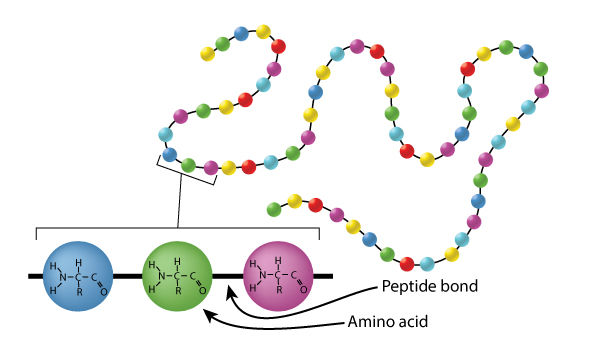
**Amino Acids join together through dehydration synthesis and the bond between 2 or more amino acids are called PEPTIDE BONDS!**
-
Dipeptides are when two ore more amino acids join together.
-
Polypeptides are when 2 to 20 amino acids join together to form a chain.
-
Proteins are polypeptides that are longer than 75 amino acids in length (ie. glucagon, insulin, enzymes).


Organization of Proteins
Stage One
PRIMARY STRUCTURE
A sequence of amino acids joined together in a long straight linear line
The organization (where each amino acid is in the long sequence) will impact the shape of the protein in later steps.


Denaturing of Proteins
The shape of a protein determines it's function. However, if the shape changes it can alter the function of the protein by denaturing it. A protein denatures if the bonding that occurs during the Secondary Structure of the protein gets disturbed. Some ways to denature a protein is to raise the temperature above 45 degrees Celsius, disrupting the pH of the protein, and heavy metals like lead or mercury.
