
THE KIDNEY
FUNCTION & STRUCTURE
-
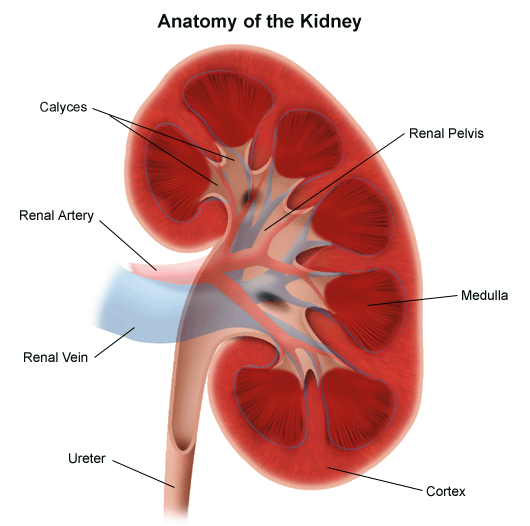
The kidney has three distinct regions; CORTEX, MEDULLA, & RENAL PELVIS
-
These regions contain all the excretory tubules called the RENAL MEDULLA and associated blood vessels.
STRUCTURE:
-
In the kidney the NEPHRON is the functional unit.
-
It is made up of a single long tubule and a ball of capillaries
-
-
The blind end of the tubule forms a cup shaped swelling called the BOWMAN'S CAPSULE, which surrounds the GLOMERULUS which is a ball of capillaries inside the Bowman's Capsule.
-
Each kidney has 1 million nephrons with a total length of 80 km where waste and nutrients is absorbed from incoming blood vessels and is either removed through excretion or diffused back into the blood at the end of the nephron.
Blood Vessels Associated with the Kidney
-
The renal artery supplies the kidney with blood
-
This artery then becomes an AFFERENT ARTERIOLE as it reaches the nephron which contains nutrient rich blood that also contains waste like urea, H+ ions, HCO2, etc.
-
-
The afferent arteriole divides into the capillaries of the GLOMERULUS which is surrounded by a swelling called the BOWMAN'S CAPSULE.
-
Once blood passes through the glomerulus, pressure filtration occurs in the Bowman's capsule and the capillaries that exit the Bowman's capsule branch into the EFFERENT ARTERIOLE which contain blood that HAS NO WASTE OR NUTRIENTS!
-
The efferent arteriole then subdivides to form the PERITUBULAR CAPILLARIES that surround the Proximal and Distal Tubules and the Loop of Henle.
-
Materials within the tubules and the peritubular capillaries diffuse between one another.
-
Tubules and Capillaries are Immersed in INTERSTITIAL FLUID
-
Anything WITHIN the nephron is called FILTRATE
-
-

FIltration & Filtrate
Pressure Filtration:
Filtration occurs due to PRESSURE DIFFERENCES between the blood plasma in the glomerulus capillaries and the fluid in the Bowman's capsule.
-
The porous membrane of the capillaries are permeable to water and small solutes (molecules). However, large molecules CANNOT pass through. The filtration process is NONSELECTIVE so any small molecule can diffuse through the membrane.
-
Filtrate in the Bowman's capsule contains salts, glucose, vitamines, urea, nitrogenous waste and other small molecules.
-
Therefore, inside the capillaries of the glomerulus there is a lower HYDROSTATIC (fluid) pressure than inside the Bowman's capsule. This allows small molecules to diffuse from an area of low pressure to an area of high pressure.
-
Pathway of Filtrate:
From the Bowman's capsule filtrate passes through 3 regions of the nephron:
-
PROXIMAL TUBULE
-
LOOP OF HENLE (Descending and Ascending Loops)
-
DISTAL CONVOLUTED TUBULE which empties into the COLLECTING DUCT
-
275 times the total volume of the blood passes through the kidney
-
180 litres of filtrate make it into the nephron
-
only 1 to 2 litres of urine is excreted daily.

Process that occur in the Nephron
-
PRESSURE FILTRATION: pressure causes blood filtrate to move out of the glomerulus into the Bowman's capsule due to pressure differences across these two areas.
-
SELECTIVE REABSORPTION: Distal and Proximal tubule selectively reabsorb useful substances back into the blood through active or passive transport.
-
TUBULAR EXCRETION: is the transfer of materials from the peritubular capillaries into the tubule.
