
THE MOUTH
FUNCTION & STRUCTURE
-
The mouth functions to receive food and then chews, moistens and digests the scratch within it. This is also where digestion begins.
STRUCTURE:
-
The mouth is made up of two palates
-
The anterior (front) hard palate and the posterior (back) soft palate also known as muscle tissue
-
The uvula (the piece of muscle that hangs at the back of your mouth), tonsils & the sides of the throat are all a part of the soft palate
-
-
-
Hunger occurs due to the combinated sneations of smelling and tasting food a swell.
-
The scent (olfactory) receptors in our nose and the receptors known as taste buds on our tongues function to remind you that you are hungry.

The Teeth
-
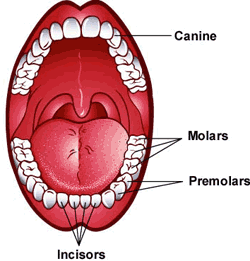
The teeth function to chew food into smaller pieces so it can be swallowed easily. It aids in the physical digestion of food.
-
A normal grown adult has 32 teeth
-
8 INCISORS for biting, 4 CANINES for feeding, 8 FLAT PREMOLARS for grinding & 12 MOLARS for crushing food.
-
-
Each tooth is also surrounded by a tough hard layer of ENAMEL (made up of calcium salts), DENTINE (thicker brown-bone-like material), and PULP (the inner layer of nerves and blood vessels inside the tooth).
-
Cavities, actually known as "caries", are caused by bacteria feeding on sugars and producing acids that corrode the tooth's enamel layers
-
"Plaque" is actually the living and dead bodies of millions of bacteria on your teeth
-
Fluoride however is used to make the tooth's enamel layer stronger so it does not decay as easily due to bacteria.
-
Gum disease known as Gingivitis (inflammation of gums) is the most common type of disease
-
It can spread to the PERIODONTAL MEMBRANE (membrane that lines the tooth socket) and can cause bone loss to occur in the socket which results in the loosening of teeth (Periodontitis).
-
-
Chewing & Swallowing
Functions of Saliva
THERE ARE THREE TYPES OF SALIVARY GLANDS:
-
PAROTID GLANDS (located below the two ears)
-
SUBLINGUAL GLAND (located below the tongue)
-
SUBMANDIBULAR GLAND (located under the mandible, known as the lower jaw)
-
When you chew food you moisten it with saliva
-
Saliva contains water, mucus and an enzyme called salivary amylase
-
Salivary Amylase is a hydrolytic enzyme that breaks down starch into its monomer maltose through chemical digestion
-
-
-
Once food has been chewed it is called the BOLUS
-
The bolus is then swallowed and passes through the back of you mouth and into the esophagus
-
The back of the mouth is called the PHARYNX which is a region between the mouth and the esophagus where swallowing occurs.
-
Why the Bolus doesn't go down your airpipe.
-
When you swallow (reflex action) you cannot breath. This is because our airpipe becomes blocked to prevent food or the bolus from traveling into our lungs.
-
SOFT PALATE moves back to cover our nose opening
-
TRACHEA (windpipe) moves under a flap of tissue called the EPIGLOTTIS and blocks the windpipe
-
If food does go down the trachea is it coughed back up
-
-
The opening to the LARYNX (voicebox) also called the GLOTTIS is also covered by the epiglottis tissue flap as well.
